We help unlock the potential of people with Down's Syndrome
Cheshire Down's Syndrome
Support Group
We help unlock the potential of people with Down's Syndrome
Cheshire Down's Syndrome
Support Group
We help unlock the potential of people with Down's Syndrome
Cheshire Down's Syndrome
Support Group
We help unlock the potential of people with Down's Syndrome
We help educate children with Down’s syndrome
What we do
Education advocacy
Our education advocates work with children, parents/ carers and education professionals to help unlock the potential of children with Down’s syndrome. They create learning targets based on the specific needs of the individual child to support development and improve communication between schools and parents of children with Down’s syndrome. In addition, they facilitate cluster groups to offer support to educators. To access the service please email schools@cdssgroup.org.uk
Makaton training
Makaton is a language programme using signs and symbols to help people to communicate. People with Down’s syndrome have strong visual learning skills so, when Makaton is used, their opportunities for social engagement and learning are greatly enhanced. We offer Makaton training to children and adults with Down’s syndrome, parents/ carers, health and education professionals. For more information or to book onto a course, see our interactive calendar of events or contact schools@cdssgroup.org.uk
Legal support
CDSSG have partnered with Irwin Mitchell LLP to provide with legal support by email and telephone on any issue falling within the scope of the retainer provided that each issue for which support is requested can be dealt with in less than 30 minutes. The types of issues covered under this retainer are issues covered by the public law team and include: • Queries about education provision • Queries about capacity or best interest disputes • Queries relating to deprivation of liberty Under the terms of this retainer, Irwin Mitchell are only authorised to speak with Julie Duff of CDSSG or another member of staff as nominated by Julie. They are unable to speak with individual parents and families unless a separate funding agreement is entered into which can be discussed depending on the facts of an individual case. If you wish to access this service then please contact admin@cdssgroup.org.uk
Speech and language support
Accessing speech and language services can be difficult for many families. We hold group sessions for pre-schoolers, offer therapy for specific children, host training, workshops and drop-in sessions as well as carry out one-to-one assessments by a Symbol UK qualified practitioner. If you need speech and language support, please contact schools@cdssgroup.org.uk
The voice of the child
We offer information, advice and training about the voice of the child. All children with Down’s syndrome have a specific learning profile. When their teaching and learning is tailored to this profile then they can reach their full potential.
Please click here to view some important and useful information about how to support your child through the current coronavirus pandemic. For more activities and information please see the resources below.
Children with Down’s syndrome have a specific learning profile, not simply a global learning delay. Over recent years there has been significant research in how best to use the child’s strengths to optimise learning.
Reading is generally a strength for children with DS. They learn to read by recognising the whole word rather than decoding phonetically. Phonics are still an important part of learning for speech sounds & for decoding as reading skills develop. There are several schemes available from Down Syndrome Education International to guide you through this process.
Numeracy is an area which children with DS typically find difficult due to the abstract nature of numbers. The use of a multi-sensory resource, such as Numicon, is highly recommended to help children ‘see how numbers work’.
CDSSG offer education settings a variety of training courses that help to unlock the potential of children with Down’s Syndrome. We also offer an education advocacy service and speech and language support. Use the bars on the right or contact us schools@cdssgroup.org.uk to find out more.
Resources to support your child with their learning whilst they are at home due to the COVID-19 pandemic.
Please scroll down for specific transition resources that may help if your child or a child you support is returning to school following the coronavirus pandemic.
An Education and Healthcare Plan that identifies the needs your child has and what support is required to meet them can be drawn up by your Local Authority (LA). You can request this from your LA but the authority is not obliged to carry one out until your child is two years old. We can provide support for your child in their specialist or mainstream setting from nursery right through their education journey. To access our education advocacy service please contact us or email admin@cdssgroup.org.uk. We also run a Cheeky Monkey pre-school group, speech and language support and life skills activities for children with Down’s syndrome.
What is the learning profile of children with Down’s syndrome?
Just like everyone, children with Down’s syndrome have strengths and weaknesses when it comes to learning and everyone is unique. Typically, people with Down’s syndrome have a specific learning profile that can include strong visual learning skills, hearing loss, speech and language difficulties, visual difficulties, low muscle tone, short concentration span and short-term listening memory.
What school is best for my child?
Every child with Down’s syndrome will have different educational needs. 80% of children with Down’s syndrome in Cheshire go to mainstream primary schools. While some children will thrive in an inclusive setting, others may be more suited to learning in a special school. Our education advocates can help you to choose a setting that is right for your child.
How will my child learn to read?
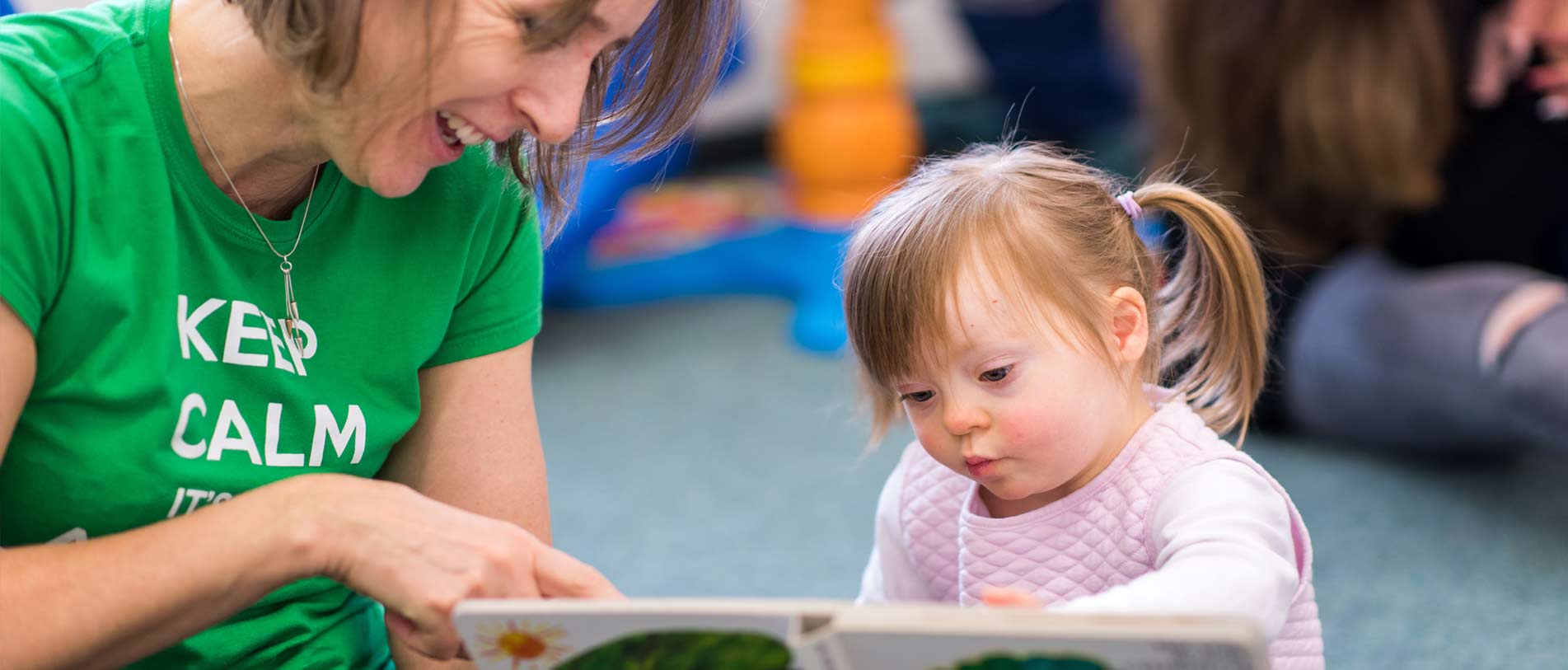
Reading is generally a strength for children with DS, as they are visual learners. The children learn to read by recognising the whole word, rather than phonetically decoding words. To enable this skill to develop we must teach the child the concept of matching; first pictures to pictures, then word to words and finally pictures to words. This method of teaching whole word sight recognition using the process of match, select, name. Any reading scheme can be used for this method of teaching by making flash cards and lotto boards. New vocabulary can also be introduced in the same way i.e. match, select, name. As reading progresses, check that the understanding of the material keeps pace.It is important children with DS are still taught phonics as they will use this for speech and when reading skills are developing.Down Syndrome Education (DSE) have developed the See and Learn Language and Reading scheme which is designed to teach children language from first words to simple sentences. DSE have also developed a detailed intervention programme, called the Reading and Language Intervention for Children with DS, which can be used with school age children to develop their reading and language skills. For more information on these schemes visit the DSE website at www.dseinternational.org
What is Makaton?
Makaton is a language programme using signs and symbols to help people to communicate. Children with Down’s syndrome have strong visual learning skills so, when Makaton is used, their opportunities for social engagement and learning are greatly enhanced. Makaton allows children to communicate with their parents and teachers straight away and allows them to express wants, needs, emotions and ideas. We offer Makaton training for parents, carers, education and health professionals. For more information, please see our calendar or contact us to express your interest.
What is Numicon?
Numicon is a multi-sensory approach, built on a proven pedagogy that raises achievement across all mathematics ability levels.Numicon’s imagery uses patterns to represent each numeral.The patterns are structured so number relationships can be seen and experienced.Numicon encourages an understanding of numbers and their relationships.Understanding numbers is reinforced through conversation and use in real-life contexts. This generalises learning and meaning of mathematical concepts. The activities incorporate rich tasks rather than worksheet or text book tasks.Numbers are abstract ideas- all we can do is show representations of them. Numicon shapes can be seen as ‘pictures of numbers’. The Numicon Approach encourages use of all structured and non-structured concrete materials. Patterns of objects, Numicon Shapes and Cuisenaire Rods are all used to give children a confident sense of ‘number’.Children with Down’s syndrome can benefit from Numicon’s visual imagery and motivating apparatus, it is the low threshold – high ceiling activities that support inclusive teaching and so Numicon really works best as a whole school approach.Breaking Barriers is the Numicon Teaching Resource Handbook for teachers of children who experience particular difficulties learning maths.CDSSG support the use and education of Numicon at home, in the Nursery/Pre-school, and at School. Our annual program usually includes a full day Numicon Training Event and a twilight training session, please see our events for details.
What is portage?
Portage is guidance on how you and your child can interact, experience and learn together through play. It is sometimes referred to as ‘inclusion’. A portage worker can offer help, advice, guidance and practical suggestions about how to enhance your child’s learning and understanding of the world and benefit them physically and mentally. We offer portage training for families. For more information, contact us or see our calendar for details.
What are P levels?
The P scale records the achievement of children up to the first level of the National Curriculum (Level 1). P levels are used by schools to help measure children’s learning progress and range from P1 (lowest) to P8 (highest). They exist for each national curriculum subject, RE and PSHE.
What is the transition plan?
It is your child’s review that concerns moving from school to further education and adult life. If your child has a Statement of Special Educational Needs, then this will happen when they are in Year 9. It can involve all the people who will be involved in supporting your son or daughter including members of your local Adult Learning Disability Team.
I’m concerned about my child’s behaviour at school, what should I do?
As all children go through different phases it’s perfectly understandable that you may be concerned about their behaviour at times. Negative behaviour may be a result of frustration or poor communication skills and can be addressed by communicating with school. Our education advocates can help you work with school to address the issues and we also run a popular behaviour workshop the dates of which can be found on our calendar.
To help personalise content and provide a better experience, we use cookies. By clicking “Accept”, you consent to the use of cookies including those served by third party data providers including Google Analytics, Twitter and Facebook.
This website uses cookies to improve your experience while you navigate through the website. Out of these cookies, the cookies that are categorized as necessary are stored on your browser as they are essential for the working of basic functionalities of the website. We also use third-party cookies that help us analyze and understand how you use this website. These cookies will be stored in your browser only with your consent. You also have the option to opt-out of these cookies. But opting out of some of these cookies may have an effect on your browsing experience.
Necessary cookies are absolutely essential for the website to function properly. This category only includes cookies that ensures basic functionalities and security features of the website. These cookies do not store any personal information.
Any cookies that may not be particularly necessary for the website to function and is used specifically to collect user personal data via analytics, ads, other embedded contents are termed as non-necessary cookies. It is mandatory to procure user consent prior to running these cookies on your website.