Campaigning for fair and equal rights for people with Down’s syndrome
What we do
Campaigns
To follow our campaigns please see @CDSSGroup (Facebook) and @cdssgroup (Twitter).
Awareness talks and assemblies
Makaton training
Communications
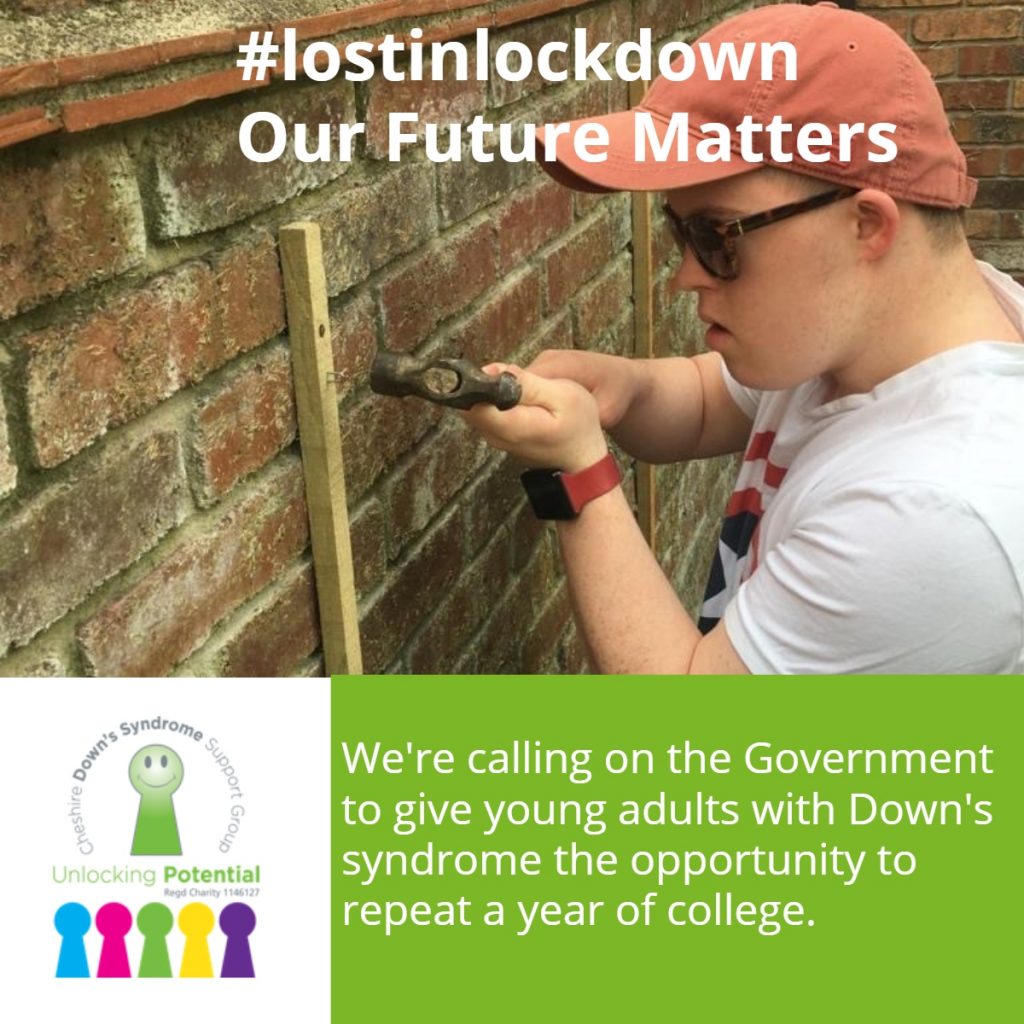
Every single person with Down’s syndrome has the right to live the life they choose. Our current campaign #lostinlockdown: Our Future Matters calls on the Government to give young people with Down’s syndrome the option to repeat a year of college.
The coronavirus pandemic has created an education crisis for all children and young people. This has been intensified for those with Down’s syndrome, many of whom have not been able to attend college due to being on the Critically Extremely Vulnerable list. They have not had the face-to-face interactions, repetition of real-life skills and opportunity for work experience needed to successfully transition into adulthood. This has resulted in extreme learning loss, which if not addressed will result in a lost generation that have not had the opportunities to build the learning and life skills needed to engage fully in society.
How you can support our campaign
Sign our petition.
Use the resource links below to help us lobby the Government by writing to your local MP and calling for action on this issue.
You can also help by spreading the word on social media. You can download campaign images to share below.
If you require more information about the campaign please contact admin@cdssgroup.org.uk
Resources
Facebook: Graphic 1, Graphic 2, Graphic 3
FAQs
What is Down’s Syndrome?
Can I catch Down’s syndrome?
Why is it called Down’s syndrome?
Are there different types of Down’s syndrome?
Trisomy 21 – with this type all the cells have an extra chromosome 21. About 94% of people with Down’s syndrome will have this type.
Translocation – this occurs when extra chromosome 21 material is attached to another chromosome. Around 4% of people with Down’s syndrome have this type.
Mosaic – in this case only some of the cells have an extra chromosome 21. About 2% of people with Down’s syndrome have this type.